China’s 2026 Outlook: Can the Fire Horse Add Some Spark?

03 February 2026
4 min read

Weak demand and steady policy temper China’s growth but provide a supportive backdrop for bonds.

The bold spirit of the Fire Horse—the presiding animal of China’s astrological calendar in 2026—is more apparent in the stellar performance of the country’s share market than its economy. As domestic demand continues to drag, the year ahead looks set to be another one of “muddling through” for policymakers. But for fixed-income investors, it could be a pleasant ride.

China is poised to begin the Lunar New Year on a positive note in two respects: it met its 2025 GDP growth target of 5.0%, and its equity market has completed its second good year  after nearly a decade of underperformance. Even the country’s policymakers seem relatively relaxed, there being no apparent sense of urgency to adjust settings to support the economy. In fact, we expect only modest policy fine-tuning and 10 to 20 basis points of rate cuts during 2026.

But underlying weaknesses persist. This was illustrated in January when the National Development and Reform Commission (NDRC) brought forward a RMB62.5 billion (US$8.9 billion) allocation of government funds to support the trade-in of consumer goods—a program aimed at buoying domestic demand. According to the NDRC, the move would help to meet “surging consumption demand” during the New Year holiday.

It was a poignant reminder of the extent to which the demand side of the economy lacks the Fire Horse’s animal spirits.

Exports Take the Fast Lane

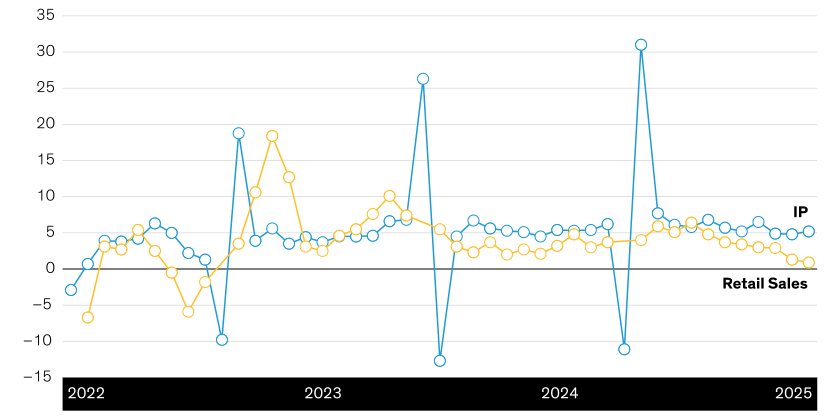
A breakdown of China’s 2025 economic performance shows that the economy continues to run at two speeds, with supply well ahead of demand. Industrial production outpaced retail sales during 2025, as it has done for several years (Display).

Industrial Production Continued to Outpace Retail Sales in 2025
China’s Year-over-Year Total Industrial Production (IP) and Retail Sales (Percent)
Line chart shows China’s industrial production growing faster than retail sales, highlighting a supply‑demand imbalance.

Historical analysis does not guarantee future results.
Through December 31, 2025
Source: Bloomberg, National Bureau of Statistics of China and Wind

The imbalance is partly a result of policy. During China’s 2021 real estate sector crisis, regulators attempted to mitigate risks to the broader economy by introducing measures to support the manufacturing sector. The move, combined with the crushing effect of the property crisis on consumers, has caused manufacturing capacity to outpace demand. This excess capacity is fueling deflationary pressures.

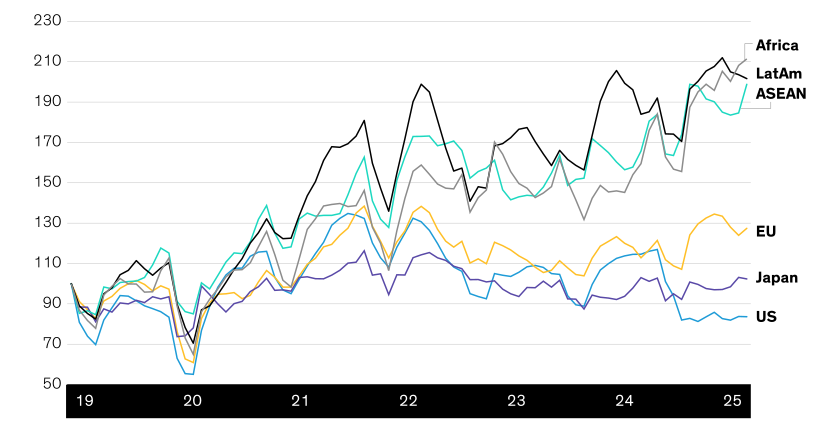
As domestic demand has faded (household consumption accounts for about 40% of GDP, compared to the global average of 64%), exports have become increasingly important in absorbing industrial output and underpinning growth. A key risk in this respect has come from tariffs imposed by the US, but China’s exporters have successfully diversified their markets. While exports to the US declined sharply in 2025, increases in sales to non-US markets more than compensated (Display).

China’s Exports Targeted Non-US Markets
China’s Seasonally Adjusted Nominal Exports (Index 2019 = 100)
Line chart showing China’s export growth rising sharply in 2025 as sales to non‑US markets offset declines to the US.

Historical analysis does not guarantee future results.
Through December 31, 2025
Source: Bloomberg, General Administration of Customs of the People’s Republic of China and Wind

Indeed, exports increased 6.1% during the year and, at RMB27 trillion, accounted for about 20% of GDP. China’s trade surplus was its biggest ever, at US$1.2 trillion.

Investment: Stuck in Reverse

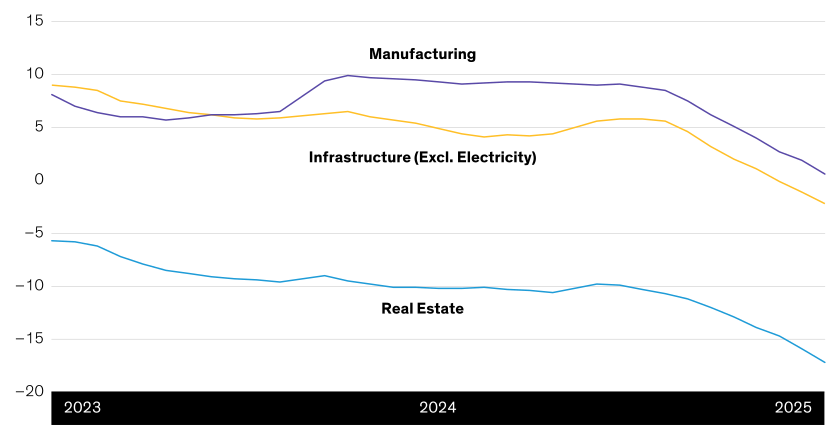
But domestic demand weakened during the year. Fixed-asset investment overall fell 3.8% and the continuing impact of the property crisis was evident in the 17.2% fall in real estate investment (Display).

Real Estate Led Slump in Fixed-Asset Investment
China’s Year-over-Year Fixed-Asset Investment (Percent)
Line charts shows property investment declined many months before infrastructure and manufacturing investment slid.

Historical analysis does not guarantee future results.
Through December 31, 2025
Source: Bloomberg, National Bureau of Statistics of China and Wind

Total retail sales of consumer goods rose 3.7%, but December figures showing a 0.9% year-over-year increase and a 0.12% month-over-month decrease suggest that the full-year figure was helped by policy initiatives undertaken early in 2025.

The Purchasing Managers’ Index (PMI) was in positive territory at 50.1 in December, but producers face headwinds. Underlying PMI trends for manufacturers in November showed that, despite strength in exports, overall orders were weak because of fragile domestic demand, while margins and profits were being squeezed by rising raw material costs and downward pressure on retail prices. The non-manufacturing sector, particularly property and consumer-facing services, was even less robust. For industrial enterprises overall, profit growth during the first 11 months of 2025 was negligible, just 0.1%.

Outlook Faces Risks on Both Sides

A more detailed picture of China’s policy outlook will emerge at the National People’s Congress in March, when the 15th Five-Year Plan will be approved, and shortly afterward with the first-quarter data release and Politburo economic meeting. But the broad objectives—to rebalance the economy by reducing dependence on exports and encouraging domestic demand growth—are unlikely to change. There are risks on both sides, in our view.

The outlook for global growth, while relatively benign on fundamentals, is complicated by geopolitical volatility. The short-term risk to China’s exports from US tariffs appears to have abated, following the one-year trade truce between President Xi Jinping and President Donald Trump in South Korea in November 2025. China’s success in diversifying its export markets is another positive. But a new challenge is emerging as some of China’s non-US trading partners push back against the deflationary effects that China’s competitively priced goods are having on their domestic markets.

On the demand side, the government has indicated that the consumption subsidy program will widen to include new items in 2026. But the additions—such as elevators in older residential buildings and fire-and-rescue equipment—are likely to be incremental rather than far-reaching in effect.

The big challenge is to find a new engine for domestic growth. Policy currently focuses on innovation and research and development in artificial intelligence, robotics, hydrogen and fusion energy, and other technology areas. But these are capital-intensive industries that are unlikely to create employment on a scale that would translate to significant growth in consumer demand.

Accommodative Settings Favor Bonds

China’s policymakers are acutely aware of the need to rebalance the economy, but in the absence of a more aggressive push to revive demand, we expect the imbalance to persist. The deflationary environment (the 2025 Consumer Price Index remained the same as the previous year’s, while producer prices for industrial products fell 2.6%) and accommodative policy settings underpin, in our view, a positive outlook this year for investors in Chinese government bonds.


The views expressed herein do not constitute research, investment advice or trade recommendations, do not necessarily represent the views of all AB portfolio-management teams and are subject to change over time.


About the Author