
Capital Markets Outlook 4Q 2025: Kicking the Can Down the Tightrope

17 October 2025
5 min read

What You Should Know

With the Fed walking a policy tightrope, investors should resist being complacent about risks and kicking the can down the road. There are opportunities across asset classes for those willing to be selective and carry a dose of caution as they assemble investment strategies.

Key Takeaways

  • Opposing macro forces are creating a tightrope for the Fed to balance on as signs of economic softening emerge. Investors should be highly selective and somewhat cautious.
  • Despite elevated equity valuations and market concentration, better earnings outlooks have benefited many segments. We see high-conviction opportunities among quality businesses.
  • In fixed income, a global approach makes sense. Yields remain compelling even with credit spreads tight, and a higher-quality high-yield market offers compelling return potential.
  • High yields, a steep yield curve with cheap long bonds and a supportive technical picture create what we see as an attractive entry point to the municipal bond market.

Strong Markets, but Signs of Economic Softening

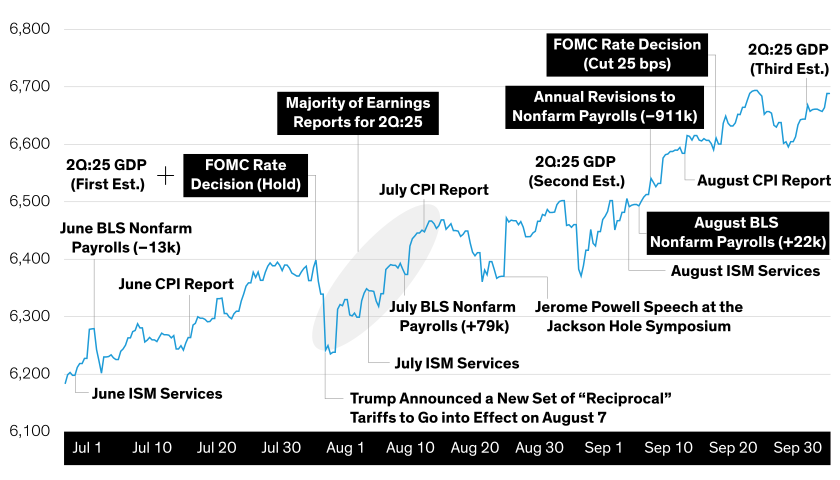
Market returns were solid in the third quarter, as the artificial intelligence (AI) trade helped push markets back up to all-time highs, even as signs of weakening emerged. Tariffs pushed prices higher in trade-sensitive sectors, and the labor market felt the Fed’s dreaded “further cooling.” As a result, the economy seems in a precarious position, with opposing macro forces complicating the central bank’s path forward.

This tightrope walk isn’t unmanageable on its own, but uncertainty remains and valuations are stretched. Faced with this environment, we think markets have become complacent about the growing macro risks—kicking the can down the tightrope as markets grind higher (Display). Going forward, we encourage investors to be particularly selective and to carry a degree of caution—though not panic.

For Investors, Good News Was Good News…but So Was Bad News
S&P 500 Price Chart (in USD)
Past performance does not guarantee future results.
BLS: US Bureau of Labor Statistics; bps: basis points; CPI: Consumer Price Index; FOMC: Federal Open Market Committee; ISM: Institute for
Supply Management
Returns are price returns; event dates are approximate.
Through September 30, 2025
Source: Bloomberg, BLS, Federal Reserve, Institute for Supply Management, S&P and AllianceBernstein (AB)

Equity Opportunities Beyond the Magnificent Seven

At the end of the third quarter, the S&P 500 was trading well above its long-term averages, and the collective share of the top-10 biggest stocks had reached new heights. While there hasn’t been a declaration that the Magnificent Seven and tech run are finished, there’s mounting concern about the massive capital spending by certain AI hyperscalers.

Improved earnings outlooks across the market capitalization spectrum has enabled other segments of equity markets, such as small-cap stocks, to join the upswing. It’s true that higher-beta, momentum and lower-quality stocks have fueled recent equity gains, but we think it makes a lot more sense to focus on identifying durable businesses that have staying power.

We see a number of high-conviction opportunities. Large-cap quality core provides optionality, as a fast-changing world and passive index concentration offer diverse active opportunities. Value seems to offer attractive price points, and many value stocks have strong earnings growth potential that should get a boost in an economic recovery (Display). Also, with an easing Fed and slow but positive growth, we think it makes sense to consider a gradual rotation into high cash-flow generators.


Not All Stocks Are Expensive, and Cheap Does Not Mean Dull

Past performance and current analysis do not guarantee future results.
YoY: year-over-year; EPS: earnings-per-share
Left display through August 31, 2025; right display as of September 30, 2025
Source: FactSet, FTSE Russell and AB

Thematically, we see an opportunity set that intersects with traditional growth and value stocks, including beneficiaries of robust power demand and capital spending on cybersecurity solutions. For investors wary of a market pullback, higher-quality, lower-beta names have been more resilient in those scenarios. And international stocks seem more intriguing today with encouraging earnings growth, more dollar weakness likely and many stocks still trading at a discount.

Bond Yields Are Still Compelling…and Potential Is Global

In bond markets, the US Treasury yield curve has continued to steepen this year, led by a decline in shorter-term yields. As a result, the pickup in yield in moving from two-year to 10-year maturities has increased; the same is true for the five-year and 30-year yield difference. US Treasury yields are lower than global bond yields hedged into dollars, which we think argues for going global.

In investment-grade credit, net supply remains manageable and demand is strong, while yields are compelling even with tight credit spreads. Investors can move up in quality from BB to BBB corporates without giving up much yield, if any (Display). In our estimation, about 50% of the BBB-rated corporate bond market offers yields similar to BB-rated bonds—the upper rung of the US high-yield market.

Investors Can Climb from BB to BBB Without Losing Much (or Any) Yield

Past performance does not guarantee future results. 
Bonds are rated by a nationally recognized statistical rating organization; AAA is highest (best) and D is lowest (worst). BBB bonds are represented by the BBB cohort bonds in the Bloomberg US Credit Corp Index. BB bonds are represented by the BB cohort bonds in the Bloomberg US High Yield Corporate Index.
The left display is from February 2010 to June 2025. The middle display shows the percent of the BBB portion of the investment-grade corporate market trading with a yield above the BB index yield at that point in time.
As of September 30, 2025
Source: Bloomberg and AB

In the high-yield market more broadly, we think valuations may foreshadow attractive returns. Credit spreads are tight, but all-in yields are still compelling, and they’ve historically been a strong predictor of future returns. The higher-quality nature of today’s market may help investors avoid defaults: defaults tend to be concentrated in CCC ratings, which today are a smaller slice of the high-yield pie.

Municipal Bonds Seem to Offer an Attractive Entry Point

Municipal bonds outperformed in the third quarter, though they still lag on a year-to-date basis. With supply levels tapering off from their summer peaks and with demand accelerating, technical conditions have become stronger.

In September, we saw dynamics shift, with expensive valuations on short bonds and support from long-duration flows driving a rally in long yields. Long-duration and high yield accounted for almost half of September’s flows. Historically, yield curve steepening has been followed by periods in which the municipal yield curve flattens, which supports outperformance by long bonds.

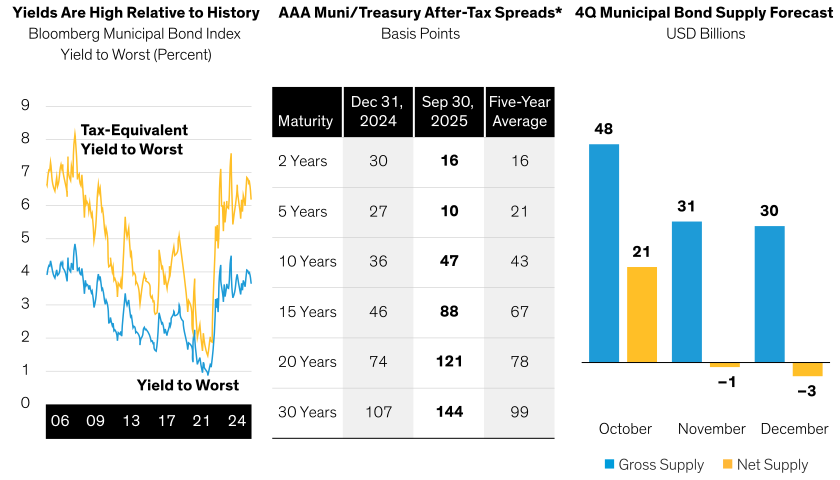
So, yields are high, relative to history, with taxable-equivalent yields on AAA municipals much higher than Treasury yields when compared with the trailing five-year average (Display). The yield curve is steep and long bonds seem cheap, and the forecast is for favorable supply levels in the fourth quarter, with expected net supply slightly negative in November and December.

Muni Yields Are High, the Curve Is Steep and Long Bonds Are Cheap
Current analysis and forecasts do not guarantee future results.
*Tax rate assumptions use a 40.8% tax rate
As of September 30, 2025
Source: Bloomberg, J.P. Morgan, US Department of the Treasury and AB

We think this creates an attractive entry point to the municipal bond market in October. As we see it, investors should consider an overweight to municipal credit with an emphasis on A- and BBB-rated bonds and overweight duration via a barbell maturity structure in high-grade bonds. And, of course, it’s important to stay active in a dynamic and fragmented market.

From a big picture perspective, we encourage investors to be especially selective in building diversified portfolios. With the economic foundation still sturdy, we think it’s also sensible to apply a degree of caution—not panic. 

The views expressed herein do not constitute research, investment advice or trade recommendations, do not necessarily represent the views of all AB portfolio-management teams and are subject to change over time.