A holistic approach may help insurance investors navigate an expansive opportunity set.
Few market sectors have struggled more than commercial real estate since the pandemic changed how people work and live. A year ago, commercial real estate debt spreads were significantly higher than those of corporate bonds, so insurance investors received compensation for taking real estate risk.
Those spread premiums are lower today. Risk assessments, meanwhile, haven’t changed much. The US inflation outlook is uncertain, given the outbreak of the transatlantic trade war. Also, rates may stay higher for longer than the market assumed just a few months ago. But while the interest-rate curve is higher than it was two years ago, it’s also more anchored. This has helped stabilize valuations and has created an environment that is more conducive to investing in real estate.
A Holistic Approach for an Expansive Market
The US commercial real estate market’s equity value was $22.5 trillion at the end of 2023, according to the Fed, with outstanding debt of $5.9 trillion. As we see it, capitalizing on the potential in such a vast market requires a holistic approach that incorporates opportunities across regions, asset types, collateral types (loans versus physical assets), and public and private markets.
We see opportunities across market segments, including commercial mortgage loans, conduit commercial mortgage-backed securities (CMBS), single asset single borrower (SASB) CMBS and commercial real estate collateralized loan obligations.
In our view, a holistic approach is better than a siloed process that segregates investments into categories—securitized loans in one bucket, whole loans in another and so forth. We think the siloed approach poses more risk of missing opportunities, duplicating exposures or both.
In Real Estate, Debt Seems More Attractive Today
Based on our view of today’s market landscape, we think it makes sense to prioritize debt over equity. Lenders’ seniority in the capital structure provides an important cushion. Equity investors face a higher risk of absorbing losses or, in extreme cases, losing all value—a risk that may grow if yields remain elevated or keep rising.
For lenders, a higher-for-longer rate environment means loans will likely remain outstanding for longer, which should increase returns. And when rates start to decline, property values and repayment activity are likely to increase.
This helps to explain why lenders have been willing to extend loans to borrowers instead of forcing sales. We expect this to continue. And while asset values have declined, we don’t think many of them have fallen far enough to make acquiring properties sufficiently cheap to justify significant equity investments.
A Good Fit for Insurance Investors
Life insurers typically allocate a sizable portion of their books to commercial real estate; allocations for property and casualty (P&C) insurers are more modest but still material. The UK Pension Risk Transfer market is showing no signs of slowing down. Last year, a near-record of about £48bn in bulk purchase annuities were written in the UK. And life insurers are seeking more options for illiquid assets with spread pickups to stay competitive in an increasingly crowded market.
US commercial real estate debt already has a home in some firms’ matching-adjustment (MA) portfolios, but there are key issues around its MA eligibility. Tailored origination, MA-focused deal structuring, and regulator-approved credit-ratings methodology are among the ingredients of success for MA firms in this market. Beyond satisfying eligibility criteria, deal maturities should be long enough to match pension liabilities. If executed effectively, deals enable insurers to access a spread premium for illiquidity and complexity. As time goes on, firms may take advantage of the newfound flexibility under Solvency UK, allowing them to cast the net wider with origination criteria.
Beyond the UK, we see commercial real estate debt as a capital efficient way to invest under Solvency II (SII). The spread advantage versus public corporates and a potentially reduced Solvency Capital Requirement (SCR) under the standard formula could enhance returns on capital. The collateral relationship to the underlying property may also lead to lower SCRs if the collateral meets the requirements outlined in Article 214 of the SII Directive. Internal model firms with specific calibrations for commercial real estate debt may also benefit from diversification in their capital calculations.
As a good source of duration and a match for both longer- and shorter-term liabilities, commercial real estate debt seems suitable for both life and P&C insurers. The private nature of the asset class gives managers more discretion in negotiating deals for insurers, originating deals bespoke to their needs.
Navigating the Credit Cycle: Where We Are
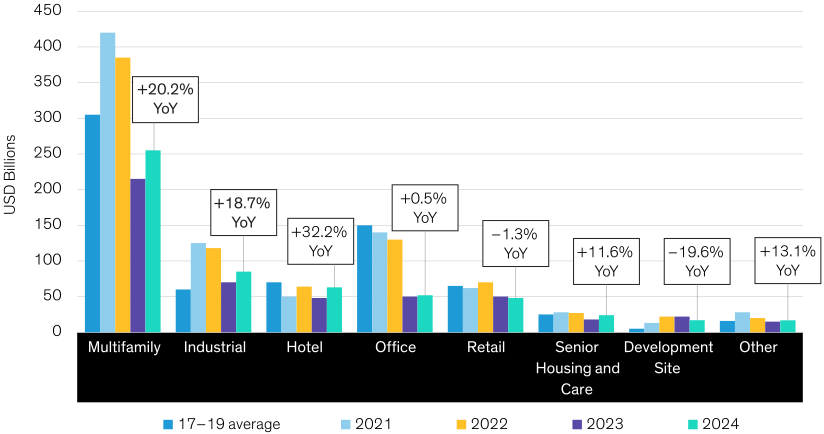
In most cases, sectors such as multifamily, industrial, hotels and retail are in relative equilibrium—a stable stage of the credit cycle. Office, perhaps the hardest-hit sector since the pandemic, is broadly in recovery. But the recovery’s length will vary based on property quality, location and employers’ return-to-office mandates.
And as the following display shows, loan origination volume is at or near pre-pandemic levels for every sector aside from multifamily and office. Compared to 2023, origination last year increased in every major sector except retail.